Marvell Raises 2028 Revenue Forecast on Strong AI Data Center Demand
The new target is above Wall Street expectations and underscores Marvell’s growing role in the rapidly expanding AI semiconductor market
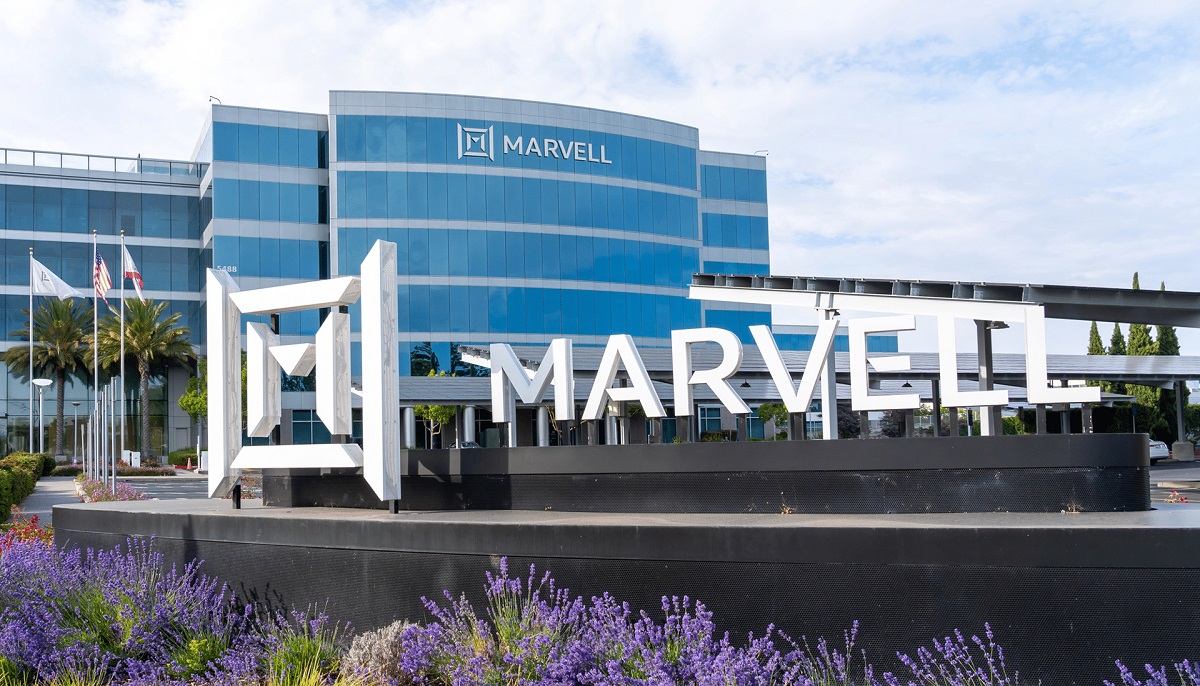
Marvell Technology has upgraded its fiscal 2028 revenue projection to roughly $20 billion, driven by demand for chips used in artificial intelligence data centers as tech companies step up investments in computing infrastructure.
The updated guidance surpasses Marvell's prior forecast of $18 billion made in August and beats the approximate $18.2 billion predicted by analyst estimates, according to LSEG data. Marvell's stock jumped following the guidance, up nearly 9% in early trading, and more than tripled this year.
AI, the umbrella term for the new wave of hardware and services, has been giving an increasing amount of lift to the company through its custom silicon business. Marvell makes chips for leading cloud and tech firms looking for customized processors for AI jobs, as well as opportunities to move away from traditional general-purpose processors.
The importance of custom chips has grown in the AI data-center market as hyperscalers build their own processors. Marvell has customers such as Alphabet and Amazon, and the pact it struck with Google over the production of its video-processing chips could earn as much as $120 billion in revenue through fiscal 2033 if a series of performance targets are met.
Marvell already increased its FY2028 guidance in August, when it raised the number from "roughly $16.5 billion" to $18 billion. The company said at the time that bookings in AI had stayed extremely high and that demand had picked up in its data-center portfolio, especially in custom chips and connectivity.
They're now forecast even more robust long-term growth. Marvell said fiscal 2031 revenue could total between $70 billion and $90 billion, with the midpoint of $80 billion far higher than the current Wall Street forecast for about $46.85 billion.
The projections anticipate that demand for AI computing will grow well past a large language model training infrastructure buildout. As companies put AI systems into use at scale and move more workloads to inference, custom processors, high-speed networking and other specialized hardware become more significant.
Marvell's guidance is amid a wave of extra funding within the wider chip trade from AI. Nvidia, Broadcom and different semiconductor corporations are also seeing the advantages of and spending on data facilities, nevertheless it is the buyers' questions on whether or not the big AI infrastructure investments will pay off that's capturing the spotlight.
If anything, the new forecast shows Marvell is confident custom silicon and data-center connectivity will be in demand for years to come. Turning that demand into sustained revenue growth will be Marvell's challenge as competitors tighten and the AI infrastructure buying spree unwinds.